
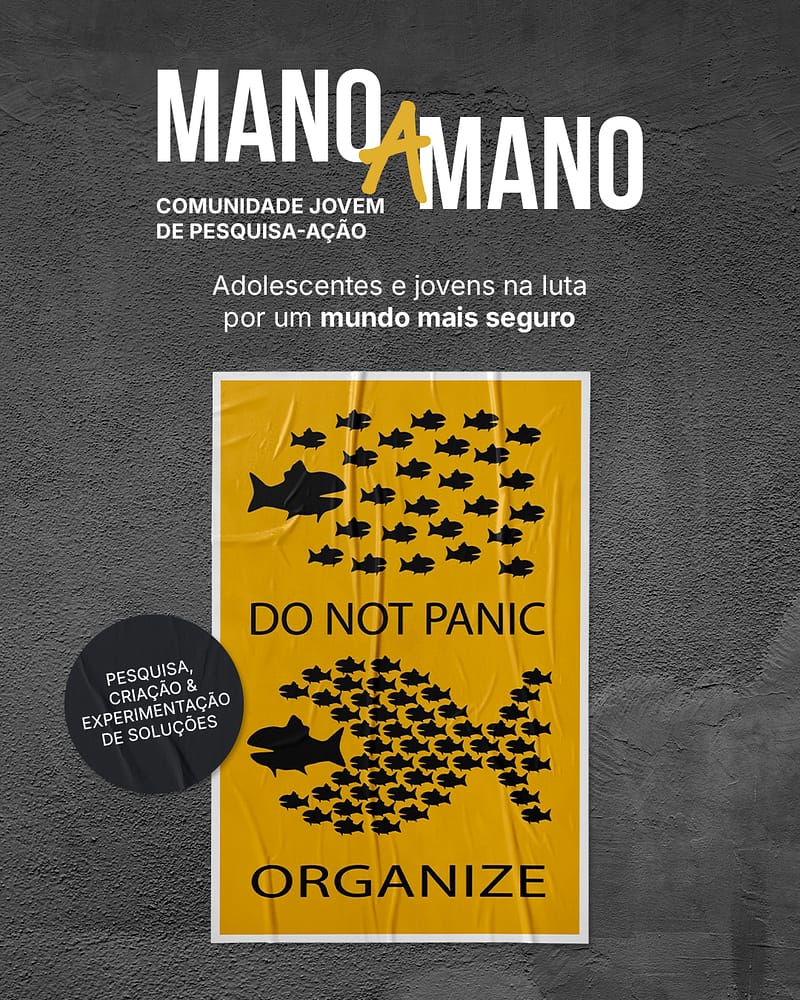
Are you between 12 and 24 years old and live in Brazil?
Do you want to be heard and empowered to confront the abuse you experience/witness in your daily life?
Are you part of a youth collective/group or willing to form one with your friends?
*limited registrations, await form response
Mano a Mano is an action-research project aimed at developing critical awareness and fostering political action among adolescents and young people regarding their safety and well-being. Its central objective is to experiment with new methods that can contribute to effective practices for youth safeguarding, considering their particular demands and desires.
The Project is part of my current post-doctoral research at the Institute of Anthropology of the Pontifical Gregorian University (Rome/Italy), carried out between 2024 and 2027.
The initiative fundamentally relies on fostering reflective-creative debate among young people and promoting community intervention. Selected participants work in small groups (3-10 people) as co-researchers/activists, encouraged to open spaces for dialogue with their peers to collectively understand their realities of violence and create tactics to tackle them.
Initially, young people participate in a series of meetings to develop their intervention project. During the project’s execution, they receive support for experimenting with the designed solutions through mentorship, access to materials, and networking provided by me. A minimum of 4 months of engagement is expected – however, this time is variable according to the project, needs, and interests of the participants.
The process of activating groups takes place between February/25 and July/26.
Subsequently, the results are analyzed, a stage that continues until January/2027. For this purpose, data systematization obtained during the monitoring of actions is foreseen; data collection through ex-ante and ex-post questionnaires (online, self-administered) with all participants; as well as narrative interviews and focus groups with selected young people.
The findings are examined considering the challenges of violence shared by the groups, and individual experiences and perceptions. The strategies used for engagement are also taken into account in the data interpretation. My interest is to observe not only how participation contributed to individual and community empowerment, but also to discuss the demands and solutions for youth safety and well-being. In view of their experiences, perceptions, and capacities, which issues were considered most relevant to address? What tactics did they invent and manage to implement to address them? What are the particular and common safeguarding challenges among the diverse and different young people involved?
In its final stage (February-July/2027), the project is described and made available to young people and professionals in the field through articles, participation in events, and the production of a booklet highlighting the practices that proved most effective.
Sample and Participant Selection
The research is characterized as qualitative exploratory. For participant recruitment, convenience and quota sampling techniques are combined, requiring the involvement of individuals between 12 and 24 years old.
Quota sampling considers the relevance of working with a varied universe of subgroups given the particularities of violence experienced according to the structural challenges of each context and the individual supports to confront them. In view of the current panorama of violence against young people in Brazil, a diversified sample is sought, especially in terms of: territory; gender; race/ethnicity; social class; and religion.
The choice for convenience sampling takes into account the objective of conducting participatory action research with young people and the recognized difficulties in engaging contemporary youth. It is understood that to make the project viable, participant selection should be based on accessibility and availability.
Based on the chosen techniques, two fronts were designed for calling adolescents and young people: opening a public call disseminated through the researcher’s personal networks and partnership with Brazilian organizations working with youth groups. In the first approach, interested parties register through an online form, either as a collective (3-10 people) or as an individual committed to organizing a Working Group with their peers to develop the project. In the second, invited organizations are offered the options of: 1) suggesting young people to form a group to be guided by the researcher and/or 2) training educators to develop projects with adolescents and young people from the organization.
The limit of participants is determined throughout the process according to adherence, sample representativeness, and the researcher’s operational possibilities.
Partners
The initiative was developed in partnership with the UFF Youth Observatory (Paulo Carrano), the Subsecretariat of Social Assistance of Volta Redonda (Larissa Garcez), the Group of Cultural Studies Identities and Interethnic Relations (Franck Marcon), and the Pensar Group (Tiago Gomes). The final form of the project had the collaboration of young activists Gustavo Gomes and Carlos Gabriel, from Volta Redonda.